
Hybrid event in Warsaw — what changes when half the audience is online
A hybrid event is not a conference with a camera at the back. What changes in the room, who is responsible for what, which parts are in the hire and which are charged on top, and the one connection question worth asking every venue.
What changes in the room when half the audience is online
A hybrid event is not a conference with a camera at the back. Five things change, and all of them are decided before the day rather than during it.
| What changes | Why | How it works here |
|---|---|---|
| The programme | Attention online runs out faster than in a room | Shorter blocks, a break every 45 minutes, questions taken throughout rather than at the end |
| The camera position | The speaker has to look at the room and the lens | Camera beside the screen, so one direction serves both audiences |
| Sound | Remote viewers forgive bad picture, never bad sound | Feed taken from the mixing desk, not from a camera microphone |
| The connection | A dropped stream is worse than no stream | The building's fibre line, separate from the guest Wi-Fi |
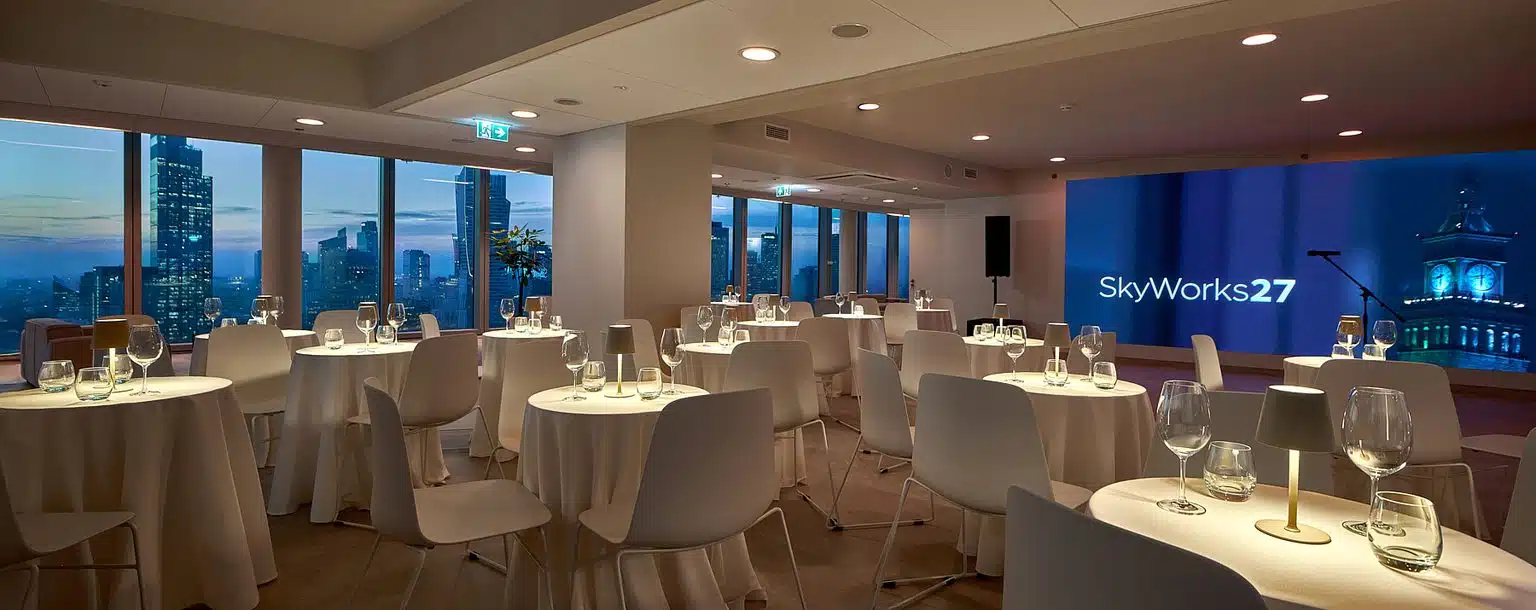
| Who is on screen | Remote participants disappear if nobody shows them | The LED wall is 2300 × 900 px, wide enough to hold slides and faces side by side |
The venue technician, and the camera operator
The split is worth understanding before you compare quotes, because venues divide it differently and the totals are not comparable until you know where the line falls.
- Venue technician — included in the hire with technical crew. Line array sound, three wireless microphones, the LED wall, DMX lighting set for the camera, the technical rehearsal, and a clean video and audio feed handed over for the stream.
- Camera operator and streaming kit — a separate, chargeable line. Camera work, vision mixing, publishing to your platform, and the recording afterwards. Our own crew runs it: outside equipment cannot be brought into the room, because the whole system is permanently installed and interlinked.
We quote the second line individually rather than publishing a rate, because a single static shot published to YouTube and a three-camera production with an edited recording are two different jobs. Tell us how many people, how many hours and where the stream should go, and we come back with a net figure. The detail is set out in our note on live streaming from a conference.
Why a whole floor suits a hybrid format
430 m² on the 27th floor of Widok Towers, hired exclusively — there is no second booking beside yours and nobody walks through the back of your shot. Daylight comes in on two sides, which matters more for a camera than it sounds: a room lit only by spotlights looks flat on a stream, and a room lit only by windows blows out behind the speaker. Here the DMX lighting balances the two.
Capacity is up to 120 theatre style and 150 standing, but a hybrid event usually works best with fewer in the room. Forty to eighty people fill the frame, stay visible, and leave space for a second camera position and for the remote audience on the wall.
A hybrid day, counted backwards from the start
| When | What | Whose side |
|---|---|---|
| At booking | Say that the event is hybrid and whether you need one camera or a production | Yours |
| 7 days before | Scope confirmed, operator booked | Ours, after your decision |
| 2 days before | Slides and video material | Yours |
| 1 day before | Server address and stream key, or access to the meeting | Yours |
| 90 minutes before | Technical rehearsal: slides, microphones, light, framing | Ours and your speakers |
| On the day | Signal test on the real channel | Ours |
| Afterwards | Raw recording; an edited version to order | Ours |
The one step organisers try to shorten is the rehearsal. It is also the step that decides whether the first ten minutes of the stream are watchable.
What organisers ask about hybrid events
What makes an event hybrid rather than streamed?
A stream is one-way: the room happens, and people elsewhere watch it. A hybrid event treats the online audience as participants — they ask questions, they are visible, and the programme is built so that they are not an afterthought. The technical difference is small; the difference in how you run the day is not.
Can we run a hybrid event on the 27th floor?
Yes. The building is on a fibre line and the stream runs over it rather than over the guest Wi-Fi, so the room's own network stays free for your guests' laptops. The LED wall shows the remote participants at a size where the room can actually see them, which is the part most venues get wrong.
What is included and what costs extra?
The venue technician comes with the hire option that includes technical crew: sound, three wireless microphones, the LED wall, DMX lighting, the technical rehearsal and a clean video and audio feed. The camera, the camera operator and the streaming kit are a separate, chargeable line, quoted individually because one static shot and a three-camera production are different services.
Can we bring our own AV company?
No. The equipment on the floor is permanently installed and interlinked — screen, sound, microphones and lighting run on one system that the venue crew operates. In practice this helps: no hours of your block lost to carrying equipment in, no argument about whose cable failed, and one team answering for both picture and sound.
How many microphones do we get?
Three wireless handhelds as standard. A fourth and any beyond that need seven days' notice. For a hybrid event, decide early who passes the microphone during questions — nothing kills a hybrid Q&A faster than an audience question the remote audience cannot hear.
Which platform can we broadcast to?
The one you already use: YouTube, Microsoft Teams, Zoom, Vimeo, a webinar platform or an internal intranet. We need the server address and the stream key, or access to the meeting if we are publishing into Teams or Zoom. Send them a day ahead so the signal test runs on the real channel rather than a test one.
How many people fit in the room itself?
Up to 120 theatre style, 150 standing, 90 at round tables. For a hybrid event the room is usually smaller than that — 40 to 80 in the room and the rest online — because the format works better when the camera can hold both the speaker and a visibly engaged audience.
How far ahead do we need to tell you?
A week before the date, at the latest. The technician schedules a signal test and, if more than one camera is needed, an operator has to be booked. Two days ahead can usually still be covered with a single camera, but without a guarantee and without time to test the platform.
Pricing, specification and a look round
The price calculator works out the cost of an event; the technical specification lists every number we have about the floor. For the space itself see the meeting room in Warsaw, the room for 100 guests or the event space.
You can see the floor before booking, by arrangement. We answer the phone seven days a week from 07:30 to 18:00; evening and weekend events are arranged individually. Polska wersja tej strony.